Silver Travertine: The Shape of a New Arrival
At the edge of a mineral spring, stone can sometimes be seen taking shape.
Water rises through the earth carrying dissolved minerals. As it reaches the surface and releases carbon dioxide, calcium carbonate begins to accumulate. Thin deposits gather upon one another, forming terraces, delicate crusts and mineral layers that gradually develop into travertine.
It is a remarkable beginning for a material that will eventually be quarried in substantial blocks, cut into slabs and incorporated into architecture.
Unlike stones whose surfaces appear almost uninterrupted, travertine carries visible traces of the conditions in which it formed. Its layers record successive periods of mineral deposition, while its natural cavities may originate from gas bubbles, vegetation or spaces subsequently altered by dissolution.
Some openings are rounded, others irregular or elongated. Depending on the deposit and the direction in which the stone is cut, they may appear as isolated markings or form part of a continuous pattern.
There is an unusual beauty in this relationship between solid material and empty space. Travertine owes much of its character not only to the minerals that accumulated, but also to the openings they left behind.
Architecture has made use of that character for centuries.
From the monumental buildings of ancient Rome to the quieter surfaces of contemporary interiors, travertine has remained familiar while continually finding new architectural expressions.
Over time, particular regions came to define much of the world's understanding of the material.
Italy established an extraordinary architectural legacy around travertine, particularly the pale varieties associated with Tivoli and the buildings of Rome. Turkey subsequently developed extensive production capabilities, bringing a remarkable variety of colours, textures and commercial selections into international markets.
Among these, silver travertine acquired a distinct following. Its cooler colouring and layered movement offered architects an alternative to the familiar warmth of traditional beige and ivory varieties.
Turkish selections became particularly prominent in international supply, while Italian and Iranian materials established their own characteristics and reputations.
Together, these sources shaped much of the international vocabulary surrounding silver travertine.
Yet the geological variety of a material is rarely exhausted by the regions that have made it commercially familiar.
Occasionally, a new source emerges with something genuinely different to offer.
Into this established market, Phoenician Stone Group has introduced Syrian Silver Travertine, becoming the first company to bring the material to international buyers at commercial scale.
The arrival represents more than the addition of another geographical origin. It introduces a stone whose individual character broadens the architectural possibilities within an already familiar category.
Its comparatively lighter silver-grey palette carries gentle tonal transitions and a restrained natural movement. Where many familiar silver travertines display pronounced bands or darker contrasts, the Syrian material offers a softer interpretation, allowing its texture to emerge without overwhelming the surrounding architecture.
There is something particularly timely about this quality.
Across a growing part of contemporary architecture and interior design, paler mineral tones, softly textured surfaces and restrained natural materials have become increasingly desirable. Designers are creating spaces in which light, proportion and texture carry much of the visual interest, allowing the character of individual materials to emerge gradually rather than dominate at first glance.
Darker stones retain their architectural appeal, but the growing preference for quiet, luminous interiors has created an especially welcoming setting for lighter natural palettes.
Syrian Silver Travertine belongs comfortably within this sensibility.
Its most remarkable distinction, however, is found in the stone's natural cavities.
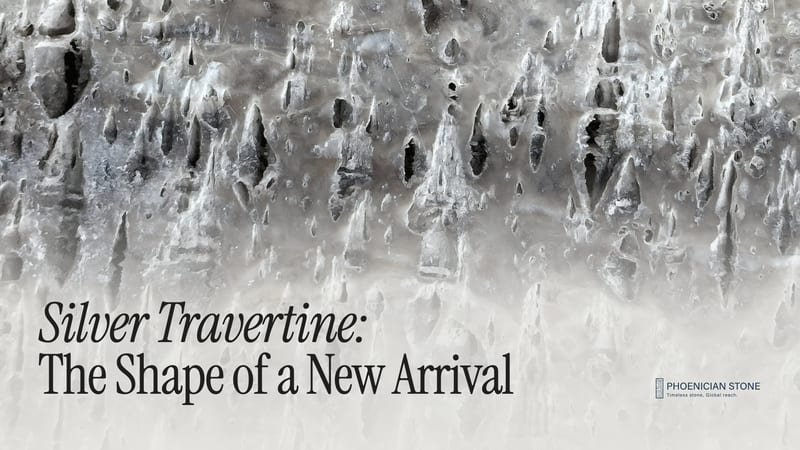
Where many familiar travertines display rounded or irregular openings, Phoenician Stone's selection reveals a recurring formation of unusual delicacy.
The cavities are elongated and gently tapered, resembling small teardrops suspended within the material.
Some appear individually, others gather across the surface, their distribution changing with the natural movement of the stone. Once recognised, these forms become difficult to overlook.
Together with its lighter silver colouring, they establish a visual identity recognisably different from many of the established selections.
For architects, these distinctions offer something beyond another colour option.
A softly coloured surface can sit alongside pale plaster, natural timber or darker architectural metals without competing for attention. Its gentle tonal variations allow generous areas of stone to retain an impression of calm, while the teardrop-shaped cavities introduce a more intricate character upon closer examination.
The direction of cutting and the choice of finish further influence how these qualities are expressed. What appears restrained in one application may reveal considerably more movement in another.
There is also an important difference between discovering an unusual stone and establishing it as an international architectural material.
The latter requires production capability, considered selection and the ability to supply quantities appropriate to real projects.
Through Phoenician Stone Group, Syrian Silver Travertine has entered international commercial supply with these practical considerations in place. What might otherwise have remained an unfamiliar regional variety can now be considered by architects, importers and distributors alongside established alternatives.
The travertines of Italy, Turkey and Iran retain the reputations they have built through their individual histories, craftsmanship and international presence.
Yet the familiarity of those selections need not define the limits of the material itself.
The introduction of Syrian Silver Travertine expands the architectural palette, offering another expression of a stone that has accompanied architecture for centuries. Its contribution lies not in resembling what came before, but in possessing a character distinctly its own.
There is something fitting about the way this particular stone announces its difference.
Travertine begins with moving water, slowly becoming solid through the accumulation of minerals. Over geological time, the finished material may become far removed from the spring that first gave rise to its formation.
Yet in this newly introduced silver variety, among the delicate layers and gentle changes of colour, remain those curious little hollows, shaped almost like falling drops.
The resemblance may be coincidental, but it is a beautiful one.
A stone born of water, distinguished by the shape of a teardrop.