What Makes a Stone Valuable?
On the Pacific island of Yap, a stone could change owners without ever being moved.
For generations, enormous circular discs known as rai served as a form of wealth and ceremonial exchange. Quarried on distant islands and carried across the sea, their value depended on more than size or appearance. The difficulty of obtaining them, the dangers of the voyage and the histories they carried all mattered.
In the nineteenth century, a trader named David O'Keefe introduced more efficient ways of quarrying and transporting these stones. His methods helped produce larger, more finely worked discs.
Yet some were valued less than older, smaller examples brought back through considerably greater effort and risk.
The newer stones were impressive objects. What they lacked was not beauty or craftsmanship, but the journeys and histories that gave the older ones their significance.
Yap's traditions belonged to a particular culture and understanding of wealth. Yet the contrast raises a question that reaches into architecture.
What makes a stone valuable?
In the natural stone industry, the first answers are relatively straightforward.
A block has a geological origin, physical properties, a cost of extraction and an appearance that may make it desirable. Rarity, dimensions, consistency and the skill required to prepare it all contribute to its commercial value.
These distinctions are meaningful. An exceptional marble may demand considerable effort to obtain and process, and its price may reasonably reflect that.
But the price of a material can be established long before anyone knows what it will become.
Once stone enters architecture, its worth begins to depend upon the place it occupies.
An extraordinarily rare marble may possess beautiful colour and movement, yet feel misplaced in a particular room. Its markings might overwhelm the proportions, or draw attention away from something the architect intended to remain quiet.
Elsewhere, a comparatively modest limestone may give a building precisely the presence it needs.
The difference is not necessarily one of material quality. Both stones may be exceptional in their own ways. What matters is the relationship between the stone and the architecture surrounding it.
Consider the familiar elements of a building.
A staircase establishes a rhythm of movement. A threshold marks the passage between two spaces. Stone surrounding a window influences the arrival of daylight, the depth of its shadows and the appearance of the facade.
Such details may seem incidental to the larger composition. Yet when carefully considered, they contribute something that an expensive material alone cannot guarantee.
And their significance rarely remains unchanged.
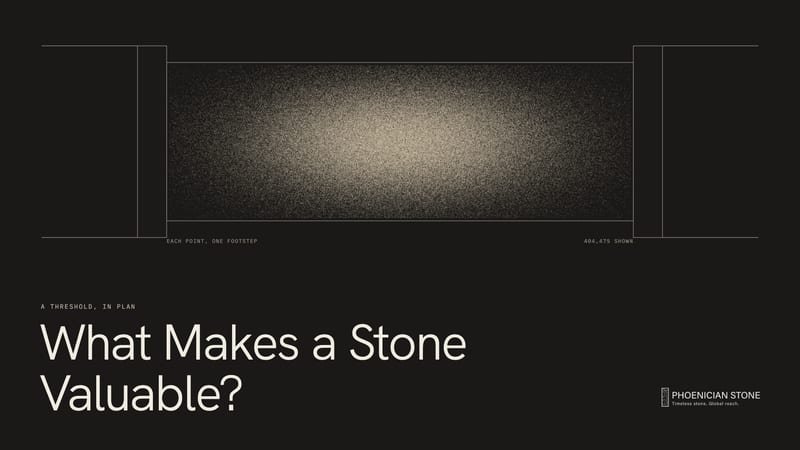
A staircase develops shallow depressions where generations have placed their feet. A threshold becomes smoother at its centre than along its edges. The stones of an old courtyard retain traces of repairs, changing uses and the ordinary passage of years.
These marks were never part of the architect's drawings. They appeared gradually, through the building's relationship with the people who inhabited it.
Eventually, they may become inseparable from the character of the place.
At Bath Abbey, in England, that relationship between historic material and accumulated meaning became a practical concern of considerable scale.
Parts of the Abbey's stone floor had begun to sink as voids developed beneath it. Restoring the surface required substantial engineering work, but the stones themselves formed part of the building's historical record.
During the Abbey's Footprint restoration project, more than two thousand floor stones were carefully lifted and restored or relaid. Among them were 891 inscribed memorial stones, carrying the names of people commemorated within the building.
The task was not simply to create a safe and level floor.
The existing stones belonged to the Abbey in ways that replacements could not fully reproduce. Their inscriptions, worn surfaces and association with that particular place gave them a significance extending far beyond the material from which they had been cut.
Preserving them required intervention, not the absence of it.
This is an important distinction. Stone can deteriorate, structural movement can create hazards, and responsible conservation sometimes demands substantial repair or selective replacement.
A worn surface is not automatically a valuable one. Nor is every sign of age worth protecting at any cost.
The difficulty lies in understanding what must change and what deserves to remain.
That same consideration belongs to contemporary architecture, although its consequences may not become apparent for decades.
Natural stone is selected through samples, specifications and drawings. Architects examine colour, texture, physical performance and suitability for the intended application. The decisions appear to concern the building as it will look upon completion.
In reality, they also concern the building it will become.
A beautiful stone poorly suited to its surroundings may deteriorate prematurely. Another, chosen with an understanding of its character and the conditions it will encounter, may remain useful and appreciated for generations.
Careful detailing, sound fabrication and considered maintenance all influence that outcome.
Durability, in this sense, is more than a material property. It is also the consequence of decisions made throughout the life of a building.
And those decisions help determine whether a surface will one day be worth preserving.
There is a curious difference between rarity and irreplaceability.
Rarity may be established through geology, availability or the unusual character of a material. These qualities can be recognised while the stone is still at the quarry.
Irreplaceability is more difficult to anticipate.
It may arise from the particular place a stone occupies, the years it has spent there and the associations that gradually gather around it.
A modest threshold can become as much a part of a house's identity as its walls or windows. Remove it, and the building may remain structurally unchanged, yet feel unfamiliar to those who have known it for years.
A replacement might be more uniform, more carefully finished, even made from a finer stone.
It would still be a replacement.
Perhaps the finest measure of a stone's value, then, has little to do with the attention it attracts when first installed.
It is whether, many years later, anyone would willingly replace it.